
Datasets:

The dataset viewer is not available for this split.
Error code:   StreamingRowsError
Exception:    TypeError
Message:      Couldn't cast array of type
list<item: list<item: list<item: int64>>>
to
{'scm': Value('string'), 'test': List({'input': List(List(Value('int64'))), 'output': List(List(Value('int64')))}), 'train': List({'input': List(List(Value('int64'))), 'output': List(List(Value('int64'))), 'cf_types': List(Value('string')), 'cf_inputs': List(List(List(Value('int64')))), 'cf_outputs': List(List(List(Value('int64'))))})}
Traceback:    Traceback (most recent call last):
                File "/src/services/worker/src/worker/utils.py", line 147, in get_rows_or_raise
                  return get_rows(
                      dataset=dataset,
                  ...<4 lines>...
                      column_names=column_names,
                  )
                File "/src/libs/libcommon/src/libcommon/utils.py", line 272, in decorator
                  return func(*args, **kwargs)
                File "/src/services/worker/src/worker/utils.py", line 127, in get_rows
                  rows_plus_one = list(itertools.islice(safe_iter(ds, dataset=dataset), rows_max_number + 1))
                File "/src/services/worker/src/worker/utils.py", line 483, in safe_iter
                  yield from ds.decode(False) if ds.features else ds
                File "/usr/local/lib/python3.14/site-packages/datasets/iterable_dataset.py", line 2840, in __iter__
                  for key, example in ex_iterable:
                                      ^^^^^^^^^^^
                File "/usr/local/lib/python3.14/site-packages/datasets/iterable_dataset.py", line 2373, in __iter__
                  for key, pa_table in self._iter_arrow():
                                       ~~~~~~~~~~~~~~~~^^
                File "/usr/local/lib/python3.14/site-packages/datasets/iterable_dataset.py", line 2398, in _iter_arrow
                  for key, pa_table in self.ex_iterable._iter_arrow():
                                       ~~~~~~~~~~~~~~~~~~~~~~~~~~~~^^
                File "/usr/local/lib/python3.14/site-packages/datasets/iterable_dataset.py", line 536, in _iter_arrow
                  for key, pa_table in iterator:
                                       ^^^^^^^^
                File "/usr/local/lib/python3.14/site-packages/datasets/iterable_dataset.py", line 419, in _iter_arrow
                  for key, pa_table in self.generate_tables_fn(**gen_kwags):
                                       ~~~~~~~~~~~~~~~~~~~~~~~^^^^^^^^^^^^^
                File "/usr/local/lib/python3.14/site-packages/datasets/packaged_modules/json/json.py", line 343, in _generate_tables
                  self._cast_table(pa_table, json_field_paths=json_field_paths),
                  ~~~~~~~~~~~~~~~~^^^^^^^^^^^^^^^^^^^^^^^^^^^^^^^^^^^^^^^^^^^^^
                File "/usr/local/lib/python3.14/site-packages/datasets/packaged_modules/json/json.py", line 132, in _cast_table
                  pa_table = table_cast(pa_table, self.info.features.arrow_schema)
                File "/usr/local/lib/python3.14/site-packages/datasets/table.py", line 2378, in table_cast
                  return cast_table_to_schema(table, schema)
                File "/usr/local/lib/python3.14/site-packages/datasets/table.py", line 2312, in cast_table_to_schema
                  cast_array_to_feature(
                  ~~~~~~~~~~~~~~~~~~~~~^
                      table[name] if name in table_column_names else pa.array([None] * len(table), type=schema.field(name).type),
                      ^^^^^^^^^^^^^^^^^^^^^^^^^^^^^^^^^^^^^^^^^^^^^^^^^^^^^^^^^^^^^^^^^^^^^^^^^^^^^^^^^^^^^^^^^^^^^^^^^^^^^^^^^^^
                      feature,
                      ^^^^^^^^
                  )
                  ^
                File "/usr/local/lib/python3.14/site-packages/datasets/table.py", line 1861, in wrapper
                  return pa.chunked_array([func(chunk, *args, **kwargs) for chunk in array.chunks])
                                           ~~~~^^^^^^^^^^^^^^^^^^^^^^^^
                File "/usr/local/lib/python3.14/site-packages/datasets/table.py", line 2158, in cast_array_to_feature
                  raise TypeError(f"Couldn't cast array of type\n{_short_str(array.type)}\nto\n{_short_str(feature)}")
              TypeError: Couldn't cast array of type
              list<item: list<item: list<item: int64>>>
              to
              {'scm': Value('string'), 'test': List({'input': List(List(Value('int64'))), 'output': List(List(Value('int64')))}), 'train': List({'input': List(List(Value('int64'))), 'output': List(List(Value('int64'))), 'cf_types': List(Value('string')), 'cf_inputs': List(List(List(Value('int64')))), 'cf_outputs': List(List(List(Value('int64'))))})}
Need help to make the dataset viewer work? Make sure to review how to configure the dataset viewer, and open a discussion for direct support.
★ 1k+ Hugging Face downloads ★
★ NeurIPS 2025 LAW Workshop – Spotlight Paper ★
★ Amazon AGI Trusted AI Symposium 2026 – Poster ★
Official project page: https://jmaasch.github.io/carc/
Overview
On-the-fly reasoning often requires adaptation to novel problems under limited data and distribution shift. This work introduces CausalARC: an experimental testbed for AI reasoning in low-data and out-of-distribution regimes, modeled after the Abstraction and Reasoning Corpus (ARC). Each CausalARC reasoning task is sampled from a fully specified causal world model, formally expressed as a structural causal model. Principled data augmentations provide observational, interventional, and counterfactual feedback about the world model in the form of few-shot, in-context learning demonstrations. As a proof-of-concept, we illustrate the use of CausalARC for four language model evaluation settings: (1) abstract reasoning with test-time training, (2) counterfactual reasoning with in-context learning, (3) program synthesis, and (4) causal discovery with logical reasoning. Within- and between-model performance varied heavily across tasks, indicating room for significant improvement in language model reasoning.
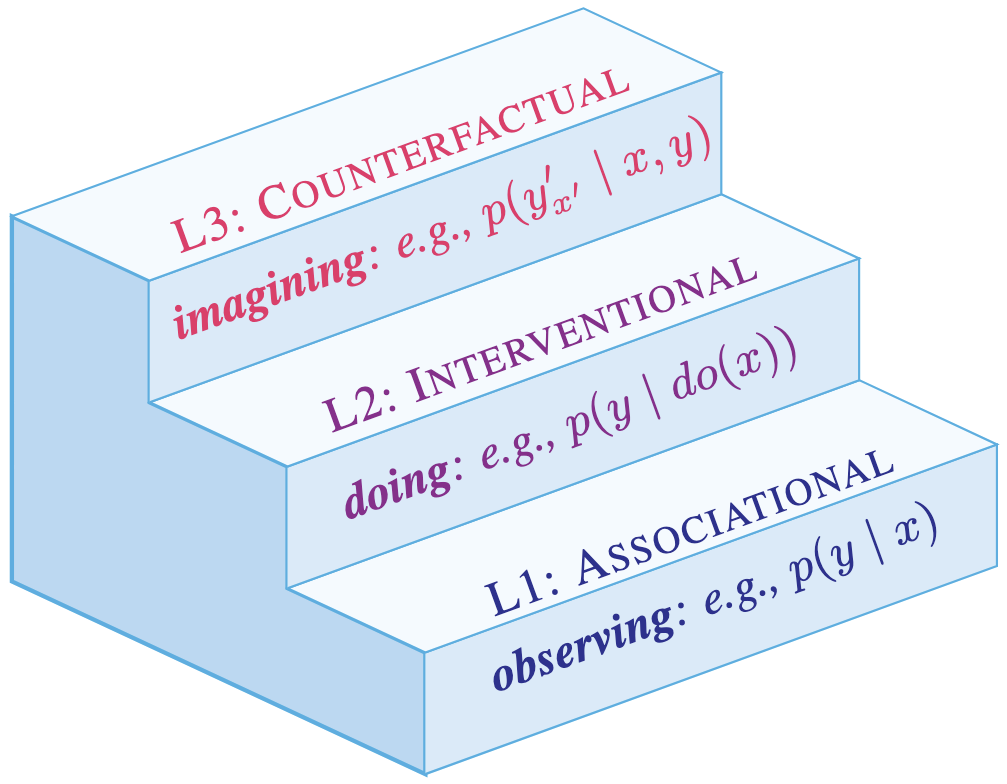 Pearl Causal Hierarchy: observing factual realities (L1), exerting actions to
induce interventional realities (L2), and imagining alternate counterfactual realities (L3)
[1]. Lower levels generally underdetermine higher levels.
Pearl Causal Hierarchy: observing factual realities (L1), exerting actions to
induce interventional realities (L2), and imagining alternate counterfactual realities (L3)
[1]. Lower levels generally underdetermine higher levels.
This work extends and reconceptualizes the ARC setup to support causal reasoning evaluation under limited data and distribution shift. Given a fully specified SCM, all three levels of the Pearl Causal Hierarchy (PCH) are well-defined: any observational (L1), interventional (L2), or counterfactual (L3) query can be answered about the environment under study [2]. This formulation makes CausalARC an open-ended playground for testing reasoning hypotheses at all three levels of the PCH, with an emphasis on abstract, logical, and counterfactual reasoning.
 The CausalARC testbed. (A) First, SCM M is manually transcribed in Python code. (B)
Input-output pairs are randomly sampled, providing observational (L1) learning signals about the
world model. (C) Sampling from interventional submodels M' of M yields interventional (L2)
samples (x', y'). Given pair (x, y), performing multiple interventions while holding the exogenous
context constant yields a set of counterfactual (L3) pairs. (D) Using L1 and L3 pairs as in-context
demonstrations, we can automatically generate natural language prompts for diverse reasoning tasks.
The CausalARC testbed. (A) First, SCM M is manually transcribed in Python code. (B)
Input-output pairs are randomly sampled, providing observational (L1) learning signals about the
world model. (C) Sampling from interventional submodels M' of M yields interventional (L2)
samples (x', y'). Given pair (x, y), performing multiple interventions while holding the exogenous
context constant yields a set of counterfactual (L3) pairs. (D) Using L1 and L3 pairs as in-context
demonstrations, we can automatically generate natural language prompts for diverse reasoning tasks.
- Downloads last month
- 50